The Raiders’ Most Important Draft Decision Isn’t the Pick. It’s the Timing.
This post is also available in:
 Español
  Deutsch
Las Vegas Doesn’t Need a Savior. They Need a Foundation.
A calm conversation about Fernando Mendoza, shiny objects, and why boring might finally work
There’s a very specific kind of electricity that only the NFL draft can generate.
It’s not rational.
It’s not patient.
And more often than not, it shows up wearing a quarterback’s jersey.
Right now, that electricity has a name: Fernando Mendoza.
Draft him at No. 1.
Figure the rest out later.
Finally give the franchise a face again.
I understand why the idea of drafting your quarterback at No. 1 overall has oxygen. I’ve lived in that headspace for years. I wanted Trevor Lawrence. I wanted Caleb Williams. I wanted Jayden Daniels — even if I didn’t want to torch three first-round picks to get him. I wanted Drake Maye.
And to be fair, several of those bets have worked out. Others haven’t — or wouldn’t have in Las Vegas. Bryce Young, Cam Ward, and even Michael Penix Jr. are good reminders that quarterback outcomes are deeply contextual.
Full disclosure: I wanted J.J. McCarthy. I wasn’t high on Bo Nix. This isn’t about being right — it’s about recognizing how fragile quarterback projections become once environment enters the equation.
Sometimes quarterbacks are shortcuts out of irrelevance.
And sometimes they’re mirrors — reflecting exactly what a franchise already is.
That’s where this conversation needs to slow down.
Starting Where the Mendoza Argument Is Strong
If you’re advocating for taking Fernando Mendoza at No. 1 in the 2026 NFL Draft, you’re not being reckless. You’re responding to the most basic truth of the NFL: quarterbacks tilt the league.
Elite ones are rare.
Acquiring them later is difficult.
And when you believe you’ve identified your guy, passing can feel like punting on fourth-and-inches with the season on the line.
Mendoza looks the part. He has the tools, presence, and that quiet gravity that makes teammates respond. On top of that many see him as a great cultural fit for the Silver and Black — myself included. You can see the future where it works — where he grows into the role, stabilizes the offense, and makes the Raiders relevant in January again.
That future exists, and it would represent a valid Raiders draft strategy.
The real question isn’t whether it’s possible.
It’s how much margin for error the Raiders actually have while chasing it.
Timing Matters More Than Talent Likes to Admit
NFL history, however, is uncomfortably consistent on one point — teams struggle when their draft strategy crowns a quarterback before the environment is ready.
Not because the quarterback isn’t talented — but because the job description becomes impossible.
He isn’t just asked to play well.
He’s asked to erase structural flaws.
To stabilize chaos.
To be the plan instead of part of it.
That’s a brutal assignment for any rookie, no matter how gifted.
Even when it works, it rarely works cleanly. And when it doesn’t, the damage spreads well beyond the player — to the coaching staff, the locker room, and the next two offseasons.
This is where the Raiders’ specific situation matters.
They don’t lack talent.
They lack margin for error.
And drafting a quarterback first overall is the fastest way to spend all of it at once.
Zooming Out: What If the Smart Move Isn’t the Loud One?
So now imagine a slightly different 2026 draft-day reality.
Elite offensive line prospects are available early and late in Round 1.
The Jets or Browns are desperate enough to overpay to move up.
The Raiders can secure a veteran quarterback with a known, functional floor.
In that world, trading down stops looking like hesitation and starts looking like intent.
Because you don’t win the AFC West by winning April.
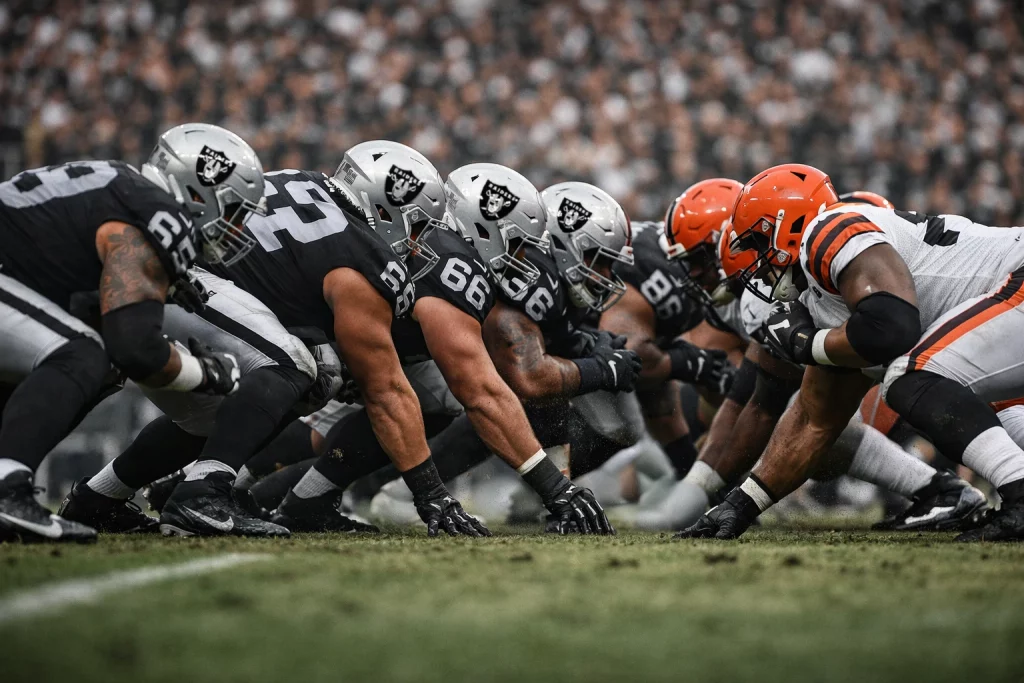
You win it by being strong and deeply annoying in the trenches.
Quietly. Repetitively. Relentlessly.
Getting not just one but two offensive linemen in the first round isn’t just fortifying the trenches — it’s reinforcing the hull before the seas get rough. I bet Al would have loved the idea of a good ol’ mean line unit. Just bruise, baby!
Why Trading Down Changes the Shape of the Season
Trading down isn’t about giving up on quarterbacks. It’s about refusing to suffocate one.
It buys time, yes — but more importantly, it absorbs mistakes. Coaches can install systems without panic. Young players can develop without being forced into savior roles. Sundays feel competitive even when things aren’t perfect.
Drafting Mendoza, by contrast, demands near-perfection elsewhere. Protection has to hold. Play-calling has to be sharp. Development has to be linear. That’s a lot to demand from a league that thrives on chaos.
None of this means Mendoza would fail.
It means the cost of being wrong is enormous.
Let’s Put Structure to Intuition: A Decision Matrix
At some point, instinct needs a second opinion.
So let’s evaluate these two possible Raider draft strategies — not emotionally, but structurally.
Scoring (1–10 scale)
| Evaluation Criteria | Weights | Draft Mendoza at No. 1 | Trade Down + OLs + Vet QB |
|---|---|---|---|
| Downside Risk | 25% | 4 | 8 |
| Roster Floor (next 2–3 years) | 20% | 5 | 8 |
| Long-Term Flexibility | 20% | 4 | 9 |
| QB Development Environment | 15% | 5 | 8 |
| Immediate Competitiveness | 10% | 6 | 7 |
| Upside Ceiling | 10% | 9 | 7 |
| Total | 100% | 5.05 | 8 |
You can debate the weights. You can tweak the scores. But unless upside is the only thing that matters to you, the conclusion keeps drifting in the same direction.
And that assumes upside is something you lose forever, rather than something that grows once the environment is right. Because a ceiling reached too early is often lower than one you build toward.
The Veteran QB Conversation (Without Panic or Romance)
This is usually where resistance sets in.
A veteran quarterback doesn’t feel inspiring. It feels like settling.
But here’s the uncomfortable comparison: do we actually believe Mendoza’s median outcome, in this specific Raiders environment, is dramatically higher than a Kirk Cousins–level quarterback?
Not his ceiling — his median.
Because if the answer is “maybe,” that hesitation matters.
It’s often economically more sound to pay reasonable money for proven quarterback competence than it is to convince elite offensive linemen to join a rebuilding team with an unproven rookie QB at the helm for top dollar. This draft class is strong in the trenches. The quarterback class is not that special.
Reverse the usual logic, and the picture sharpens quickly.
What “Overpay” Actually Means (Jets & Browns Edition)
Update: Dante Moore has announced he’s returning to college, which tightens the top of the quarterback market and increases the leverage attached to the No. 1 pick.
At this point, it’s fair to ask what “overpay” even looks like in practical terms.
This isn’t about fleecing anyone. It’s about leverage — and both the Jets and Browns are the kinds of organizations that historically pay premiums when quarterback desperation meets draft proximity.
For the Jets, holding the second and sixteenth overall pick, a realistic framework would start with:
- their second overall
- plus their second first-round pick or a high day-2 compensation
With Dante Moore returning to college, paying extra isn’t about being aggressive — it’s about controlling the only clean path to the quarterback you believe in this year.
That’s not reckless. That’s the cost of climbing into the driver seat of the draft and eliminating any guess word when you believe one quarterback meaningfully separates himself from the rest of the class and you suspect you could be jumped.
The Browns, operating lower in the order but with arguably more urgency, would be working from a slightly different place:
- their sixth overall pick
- their late first-round pick
- and future draft capital to bridge the gap (even another future 1st rounder would not be outragous)
In both cases, the logic is the same. If a team believes the difference between Mendoza and the next quarterback tier is real, the extra pick isn’t a luxury — it’s insurance.
From the Raiders’ perspective, that’s the entire point. You’re not just moving back. You’re converting quarterback desperation into structural stability.
This is also where discipline matters. Trading down only makes sense if the return allows the Raiders to execute the vision outlined above — not in theory, somewhere in the future, but immediately.
Deals with teams like the Jets or Browns work because they preserve premium capital in the current draft. Two first-round picks this year can fundamentally change the offensive line overnight. That’s the point.
A trade-up from a team like Arizona or New Orleans likely looks different — future picks, delayed payoff, less immediate trench impact. That kind of return is still valuable, but it doesn’t solve the same problem. And if the Raiders can’t materially fortify the line right now, the calculus changes.
In that scenario, drafting Mendoza becomes far more defensible. The argument isn’t “always trade down.” It’s “trade down only when the structure actually improves.”
“This Would Never Happen” — Until It Does
The most common pushback to scenarios like this is simple: no team would ever pay that much.
But that objection imagines trades happening in a vacuum.
They don’t.
Draft prices spike not because a deal is fair, but because someone is afraid of being jumped.
If the Jets believe the Browns are willing to move aggressively, standing still becomes the risky option. If the Browns think the Jets are one phone call away from securing Mendoza, waiting turns into a gamble. In that environment, the extra pick isn’t indulgence — it’s insurance.
And now one major pressure valve is gone: Dante Moore is returning to Oregon. When alternatives disappear, conviction gets expensive fast. Front offices don’t just draft quarterbacks — they draft convictions. And when a team believes one player is meaningfully their answer, the cost of certainty often outweighs the appeal of standing pat.
That’s how draft rooms actually behave. Leverage compounds when multiple teams want the same outcome, and the team holding the premium position doesn’t need consensus — it only needs one believer.
This isn’t about predicting behavior. It’s about understanding incentives — and incentives, not restraint, are what usually decide draft-trading-prices.
Why This Lets the Entire Offense Breathe
You already know this but it’s still worth mentioning: Football is brutally interconnected.
Better offensive line play creates cleaner pockets.
Cleaner pockets improve timing.
Better run blocking lightens boxes.
Lighter boxes simplify reads.
A top-15 quarterback behind a strong line is often more valuable than a rookie “maybe-elite” quarterback improvising under siege.
And if the veteran quarterback isn’t the long-term answer?
That’s fine.
The line stays.
The run game stays.
The team stays competitive.
You haven’t trapped yourself.
The High-Wire Act vs. the Construction Site
Drafting Fernando Mendoza at No. 1 is a moonshot 🌙.
If it hits, you look brilliant.
If it misses, you burn elite draft capital, years of flexibility, and probably a coaching staff.
Trading down isn’t exciting. It’s scaffolding. It’s rebar. It’s the unglamorous work that doesn’t trend — but holds when the weather turns.
That’s how you build a ship that survives the season, not just the launch.
Verdict 🏴☠️
Drafting Mendoza first overall isn’t foolish.
But it is fragile.
Trading down, stacking picks, and fortifying the line lowers downside risk, raises the roster floor, and keeps future options open — without closing the door on finding a quarterback when the environment is finally ready to support him.
It’s also worth remembering that quarterback opportunity doesn’t end with a single draft. Every year introduces new profiles, new ceilings, and new risks — and those variables tend to reward teams that operate from stability rather than urgency.
That isn’t an argument for waiting on a specific name or chasing the next savior. It’s an acknowledgment that patience preserves optionality. And optionality matters far more when the foundation underneath it is already strong.
The Raiders don’t need a savior.
They need a foundation.
And sometimes the smartest move is the one that feels boring — right up until it starts winning in December.
As with most draft theories, there’s one inconvenient prerequisite here: someone has to pay. If the Jets and Browns suddenly discover restraint, this entire exercise gets a lot less fun.